
Disclaimer: Not financial, life, or investment advice. I own shares in AUS and CAUS companies and plan to buy more.
If you don't really care what I think and just want a list of companies, you can skip ahead.
TL;DR: there are already a lot of good drone market maps. A few worth bookmarking:
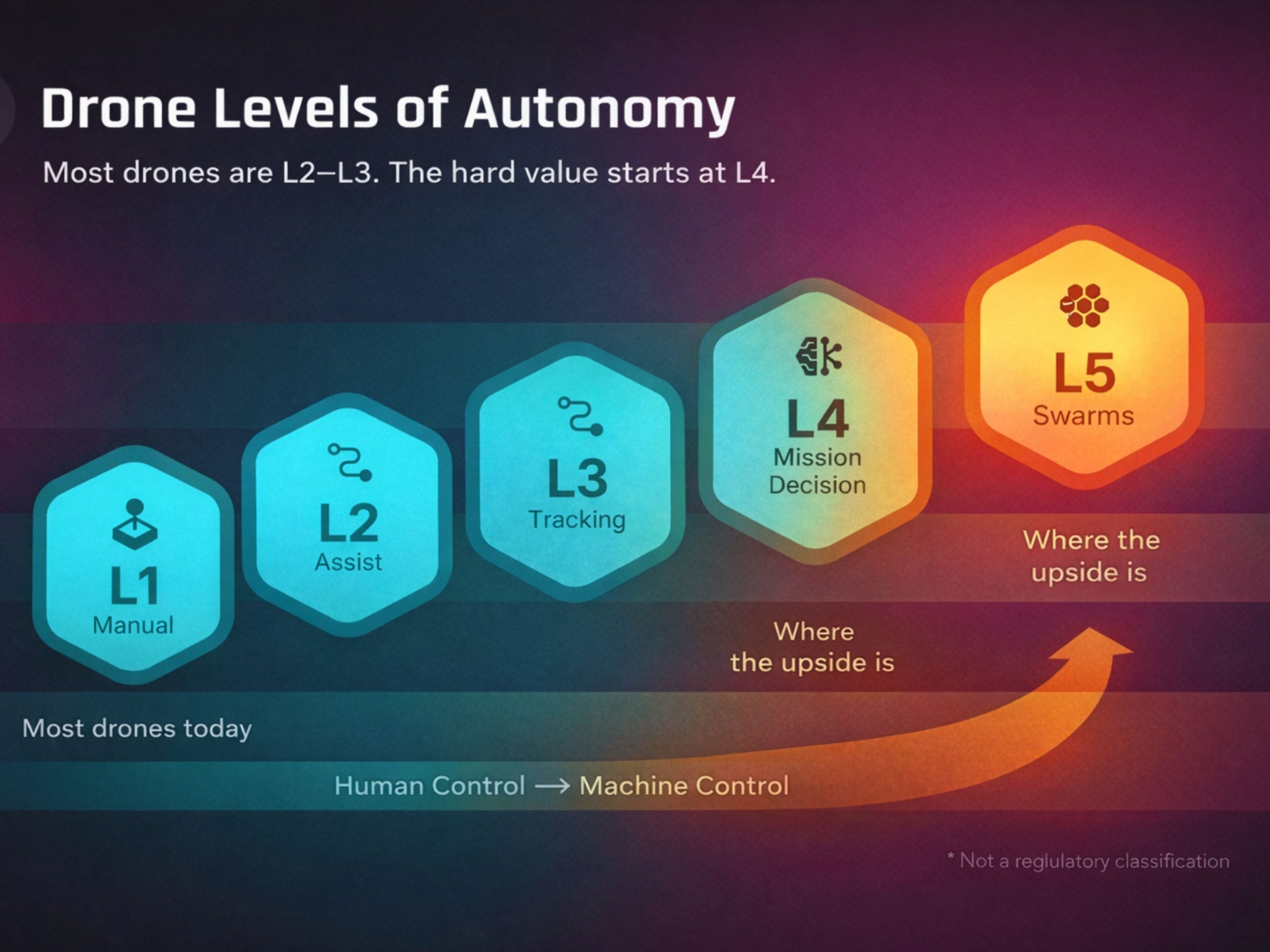
What follows is not another market map. It's a framework: the 5 Levels of Drone Autonomy, from remote-controlled flying cameras (Level 1) to AI-driven autonomous swarms that start to resemble Skynet's hunter-killers (Level 5).
PART 1: Drones "So What?"
Drones can deliver your burrito. Drones can help firefighters find you faster than an ambulance. Drones can also, apparently, destroy nuclear infrastructure. Which is not nothing.
For a long time, drones were treated as gadgets: cool demos, great YouTube videos, questionable Christmas gifts. In 2025, they became something else entirely: a line item, in consumer P&Ls, municipal budgets, and military balance sheets.
Start with Burritos
In 2025, the U.S. saw its first public burrito delivery by drone through the Zipline × Chipotle partnership. This wasn't a pilot or a PR stunt. It was a national brand deciding that a two-pound burrito should not be delivered by a two-thousand-pound car, and that a drone is both faster and cheaper.
This wasn't new technology. Wing had been flying deliveries since 2019. What changed was permission: regulatory, economic, and social.
Then Cities Followed
In 2025, FAA-approved Drone-as-First-Responder programs jumped from roughly 50 U.S. cities in 2024 to ~600 in 2025, a 10× increase in a single year. This still represents less than 5% of the cities where drones could plausibly be deployed, which is another way of saying: adoption has started, saturation has not.
Then War Removed Any Remaining Ambiguity
In Ukraine, roughly $1M of drones was used to destroy an estimated $7B of Russian nuclear-related infrastructure in the Spiderweb attack. This is not a debate about ethics or strategy. It is a spreadsheet with an unsettling ratio.
Institutions noticed. In early 2026, the Department of Homeland Security created a dedicated drone division, PEO-UAS/C-UAS. When the bureaucracy names a thing, the thing is real. ("Drone division" would have been better alliteration, but no one asked.)
Safe to say: drones took off in 2025. What happens next will determine who controls the air, the data, and the rules, and who finds out last.
PART 2: The 5 Levels of AI for Drones
At this point you might reasonably think: Drones took off in 2025, AI on drones must be incredible now.
This is mostly wrong.
As of 2026, the U.S. Department of Defense is not even cleanly classifying how drones use AI to coordinate with one another. Not because it's classified brilliance, but because it's genuinely very hard.
Autonomous swarming requires real-time perception, distributed decision-making, resilience to electronic warfare, and coordination under uncertainty. The people best equipped to solve those problems are currently working on self-driving cars, humanoid robots, and data centers. Drones, for now, are borrowing pieces of that stack.
What follows is a practical autonomy ladder based on capability levels.
Level 1: Full Manual
How it works: A human operator controls the aircraft directly via joystick or screen. Software may stabilize flight, but there is no autonomy. Comparable to driving a classic car: fun, fragile, unforgiving.
Technology: Radio control, servos, motors, minimal or no flight computer.
Examples: FrSky, RadioLink, BadassMotors
Level 2: Pilot Assistance / Basic Autonomy
How it works: The drone can hold altitude, maintain speed, and follow waypoints, but cannot reason about context. Comparable to adaptive cruise control.
Technology: Level 1 stack, IMU/GPS/barometric sensors, flight controllers, sensor fusion, ArduPilot / PX4.
Examples: 3DR, DJI, CubePilot, Pixhawk, Russian STC (Orlan)
Level 3: Operator-Assisted Object Tracking
How it works: An operator designates a target, sometimes with object-recognition assistance. The drone can follow or intercept but still relies on human judgment for major decisions. Comparable to lane-keep or parking assist.
Technology: Level 2 stack, basic computer vision, substantial onboard processing.
Examples: Zala Aerospace (Lancet), Swarmer, DJI, Anduril, BlueArrow, AeroVironment, Russian unit Rubicon, NVIDIA
Level 4: Dynamic Missions & Environmental Adaptation
How it works: The operator uploads a mission and launches. The drone autonomously navigates terrain, prioritizes objectives, and adapts to degraded or denied conditions. This is where drones begin to function meaningfully under electronic warfare.
Technology: Advanced computer vision, terrain recognition, obstacle avoidance, situational awareness, higher-level decision software, more compute.
Examples: UATechnology, Vermeer, Sentinel, Auterion, BlueArrow, Shahed Aviation Industries, Helsing, NVIDIA
Level 5: Fully Autonomous Swarms (MITL Optional)
How it works: Multiple drones self-organize, distribute tasks, adapt tactics, and complete missions with little or no human input after launch. Operators may supervise but are not required. Comparable to a fully autonomous city of vehicles, except the stakes are higher.
Technology: Mesh networking (MANET), distributed computing, homogeneous or heterogeneous swarming algorithms.
Examples: Swarmer, Vermeer, Sentinel, ACS, China Electronics Technology Group Corporation
The Takeaway
Most drones flying today, even in combat, are Level 2 or Level 3 systems. The economic and geopolitical impact of drones arrived before true autonomy did.
The paradox is that drones reshaped warfare and cities before solving autonomy, meaning the largest economic upside sits in the hardest, least crowded part of the stack.
Three Good Ideas
If you want to start a company, here are three good ideas.
1. Autonomy in Denied Environments
VC Backability: 9.5 / 10
Why it works: This is the core unsolved problem. Winners sit high in the stack with software-driven margins. Dual-use (defense + industrial) expands TAM without fragmenting product. Moats come from data, iteration speed, and survivability under real conditions.
Why it's hard (and good): Long R&D cycles. Elite talent requirements. Early traction often looks unimpressive, until it suddenly isn't.
VC takeaway: If this works, it becomes foundational infrastructure, not a feature. This is where category-defining companies come from.
2. Parts That Don’t Fail First (Brushless Motors, Power, Actuation)
VC Backability: 6.5 / 10
Why it works: Massive volume potential. Clear pain points in attrition-heavy environments. Strong pull from defense, drones, robotics, and industrial automation.
What limits upside: Margins compress. It's hard to avoid becoming "just a component supplier." Differentiation must be proven in the field, not on spec sheets.
VC takeaway: This can be a great company, but usually exits via strategic acquisition or scales into a manufacturing business, not a standalone unicorn.
3. Manufacturing for Attrition
VC Backability: 7.5 / 10
Why it works: Manufacturing speed and iteration are now strategic weapons. Attrition-based demand creates repeat purchasing. Strong alignment with geopolitical tailwinds and re-industrialization. In 2025, Despite growing "drone fatigue" in venture, the production gap is stark: the West and Israel produce ~15,000 mid-strike drones (Altius, Switchblade) per year versus ~100,000 for Russia (Shahed, Lancet) and ~1,000,000 for China.
What makes it tricky: Capital intensity, supply-chain risk, and the danger of scaling before demand stabilizes.
VC takeaway: This is venture-backable if the company controls the process, not just the factory, and couples manufacturing with design or software leverage.
The End.